
In recent months, in the logistics and transport sector, there has been no other topic of discussion: the new regulations on stops during loading and unloading operations are reshaping the rules of the game. For years, downtime has been perceived as a 'necessary evil'. But today, with the coming into force of the Infrastructure Decree 2025, ignoring them can be costly. For companies and, in turn, for the entire supply chain.
When a vehicle stops, the company does not stop spending. In fact, a series of direct and indirect costs begin to impact the entire operational flow:
- Direct operational costs: driver waiting, wasted fuel, resource occupation.
- Chain delays: an unexpected stop can compromise subsequent deliveries.
- Loss of rotations: fewer trips completed in a day, less profitability per vehicle.
- Logistical stress: warehouse overload and congestion of yards.
The rule is clear: 90 minutes of grace, then an automatic charge of 100 euros per hour kicks in. It doesn't matter if the driver arrived early or if there was a mix-up at the warehouse: the clock starts ticking from the moment the truck crosses the threshold of the loading or unloading point. And proof can also be provided by the smart tachograph or the vehicle's telematics data.
This is an important stance, which finally aims to protect the work of hauliers and hold all actors in the logistics chain accountable. But the question many are asking is another: are we really ready?
Daily inefficiency times weigh on costs
In Italy, inefficiency at loading is a structural problem. A study by the University of Milan Bicocca conducted on over 80,000 working days revealed that a driver spends on average more than four hours a day stationary for loading or unloading. This is not about breaks or delays: these are operational hours in which the vehicle is waiting, in a yard, in front of a dock, unable to produce value.
If we consider an average annual labour cost of 65,000 euros per driver, multiplied by the lost hours and the number of vehicles in circulation, it is easy to reach tens of millions of euros in inefficiencies distributed on a national basis. But it is not just a matter of money: it is a matter of organisation, competitiveness, and respect for those who work on the road and in the warehouse.
Waiting hours do not arise by chance. They are often the result of a lack of coordination between the warehouse and transport. The most common causes are:
- The load has not yet been prepared.
- The slot is occupied by another vehicle that is delayed.
- There are not enough operators available to load/unload.
- The documentation is not ready.
- There is no shared planning of time slots.
And these are not isolated cases. According to a report by Agenda Digitale – Supply Chain Planning Observatory of the Politecnico di Milano (2024), as many as 72% of Italian companies do not have an advanced system based on digital technologies (such as IoT, AI or integrated solutions) for tracking and planning flows along the entire supply chain.
This means that only 28% of businesses have already adopted structured systems to manage arrivals, movements, and logistics operations more efficiently.
The new regulations help to reorganise the situation, but they are not exhaustive.
The regulations certainly have the merit of introducing transparency. Today, anyone receiving a haulier is obliged to provide clear instructions on the unloading time and the exact destination. They must be ready to receive the vehicle within certain timeframes. If they fail to do so, they pay. It is a simple principle of fairness and responsibility.
However, as is often the case, the operational reality is more complex. Trade associations have received the reform in a mixed manner: some see it as a victory for the sector. But there are also those who report a lack of automatic controls, fearing that compensations will become worthless in the event of disputes and bureaucratic delays.
An additional effort is therefore needed. Companies need to start viewing delays not just as a problem to be 'charged for', but as an opportunity for internal reorganisation.
Strategic optimisation is crucial for competitiveness today.
Today, thanks to digitalisation, there are concrete tools to improve the management of arrivals. Some companies have already started mapping their flows, identifying peak times, and making access to the docks smoother. Yard management systems and smart cameras allow for real-time monitoring of the yard, predicting congestion points, and reducing waiting times.
But the most important cultural change is another: the awareness that loading and unloading are not simple "appendices" of transport, but key processes in the supply chain. The time a lorry spends stationary is time that weighs on the balance of the entire supply chain, from the producer to the distributor, to the end customer.
Slot booking: not just technology, but a method
And this is where one of the most effective and simultaneously most underestimated solutions comes into play: the slot booking system.
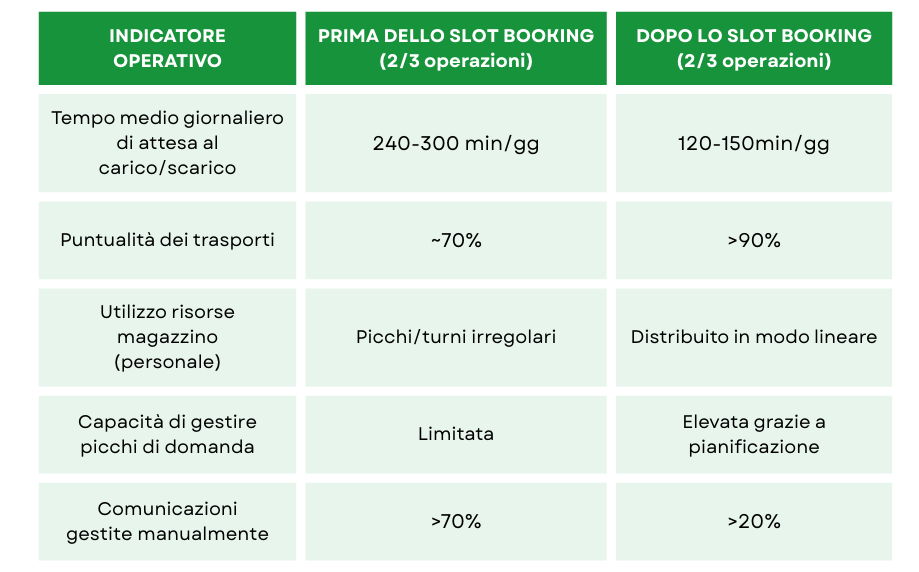
It is not just a platform where the driver books a time slot. It is much more than that. It is an organisational approach that imposes order, scheduling, and dialogue. It means knowing in advance who is arriving, when, where, and what they need to do. It means evenly distributing the workload in the warehouse, avoiding peaks and overlaps, improving resource utilisation, and – not least – offering more sustainable working conditions for those operating at the docks.
Companies that have already adopted slot booking clearly report: waiting times are drastically reduced, in some cases by 60-70%. Staff are less stressed because they work on predictable flows. Transporters are more productive because they can make more trips in a day. And the end customer receives the goods on time, without surprises.
Furthermore, significant increases in dock productivity and improvements in delivery punctuality have been observed. The issue of loading stops is no longer just an operational matter. It has become a strategic topic. Because it reflects the organisational maturity of a company, its ability to adapt to change, and to respond to market needs with new tools.
The suggestion? Start with an internal analysis: how long do your vehicles wait? How much does each lost hour really cost? How many trips could you recover if you optimised access to your warehouse? And then, consider whether it makes sense to start a pilot project for slot booking, perhaps at a single site or for a single customer.
Ultimately, it is not just about reducing costs. It is about making your supply chain more resilient, more transparent, more sustainable. And today, this makes the difference between falling behind and leading the change.