
In the world of international trade, many companies focus on logistics, contracting, and import and export regulations. However, one of the most relevant and often overlooked aspects is the origin of goods. The correct identification of a product's origin is not only a legal obligation but represents a crucial factor that can have a direct impact on operational costs, legality, and, above all, business competitiveness. Incorrect identification of origin leads to a violation of the European Union Customs Code (Regulation (EU) No. 952/2013) and exposes the company to administrative or criminal penalties under national law. The origin of goods is not limited to the geographical concept but concerns the precise identification of where and how a product is made or transformed, following rules established by customs regulations. For companies operating internationally, managing this aspect correctly can make the difference between an efficient and profitable business operation and one subject to errors and penalties. This topic, often perceived as a technical detail, is actually one of the fundamental pillars of customs and trade compliance.
The hidden complexity of customs origin
The concept of the customs origin of goods is intricate and complex. International customs regulations primarily distinguish between two types of origin: non-preferential and preferential. While the former is determined by the country in which the product has been wholly produced or significantly transformed, the latter pertains to situations where the origin of the product guarantees substantial economic benefits in the form of exemptions or tariff reductions, thanks to free trade agreements.
For many companies, the real issue lies in understanding which of the two categories applies to their products and, above all, how these distinctions can impact their business operations. In a globalised world, where supply chains involve multiple countries and a multitude of suppliers, it is easy to make identification errors. This can lead to costly consequences: from undue duties to delivery delays, and even legal sanctions for regulatory violations, which can result in significant fines and the seizure of goods. Financial penalties can vary based on the severity of the violation and can exceed 10% of the value of the goods in cases of fraudulent or incorrect declarations.
The applicable regulations in this context are governed by Articles 59 to 64 of the Union Customs Code (Regulation (EU) 952/2013), Articles 31 to 70 of Delegated Regulation (EU) No. 2446/2015, and Articles 57 to 126 of Implementing Regulation (EU) No. 2447/2015. These rules regulate the application of preferential and non-preferential tariff measures (for example, anti-dumping duties and countervailing duties), as well as affecting the protection of designations of origin, such as "Made in Italy" and the Madrid Agreement.
Often, businesses underestimate the importance of correct origin declaration, believing it to be merely a bureaucratic requirement. However, origin is a strategic aspect that can determine the success or failure of business operations, directly affecting costs and profitability. Making mistakes or ignoring regulations related to origin means exposing one's company to legal, economic, and reputational risks.
The penalties for incorrect or misleading declarations are severe. Importing or exporting products with false or misleading indications of origin, as provided for by Article 517 of the Penal Code, can result in up to two years of imprisonment and a fine of up to 20,000 euros. Furthermore, presenting products with false indications of origin at customs or for retail sale carries economic and legal risks. Such violations can be remedied by correcting the indications, but they still expose companies to serious reputational and commercial consequences.
Non-preferential origin: understanding the implications
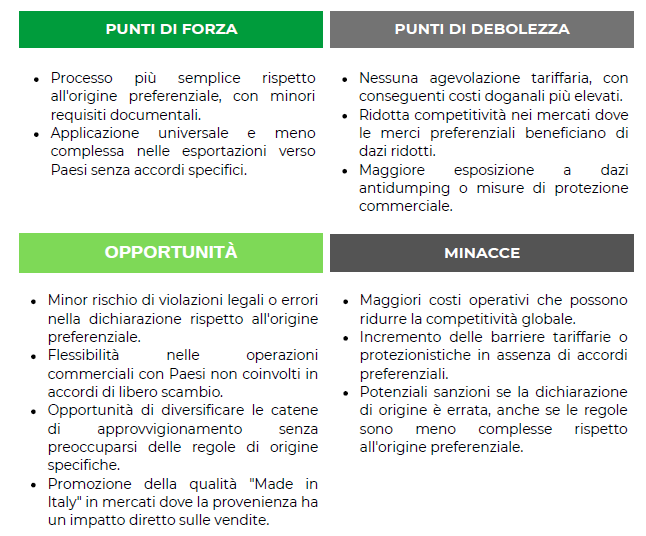
One of the scenarios in which the origin of goods plays a critical role is the importation of goods from foreign markets. Many countries require businesses to provide a non-preferential certificate of origin to ensure that the goods comply with current trade regulations. This document, while not guaranteeing tariff concessions, is essential for monitoring the application of measures such as anti-dumping duties and import restrictions.
Let us take the example of a company that exports chemical products to a market with strict anti-dumping regulations. If the certificate of origin is not produced correctly or if the origin is declared incorrectly, the company could be subject to high duties or, in more severe cases, its goods could be blocked at customs, with disastrous consequences for the business. Furthermore, the risk of sanctions for non-compliance with international trade regulations, such as those established by the World Trade Organization (WTO), could further jeopardise its reputation.
Preferential origin: a lever for competitiveness
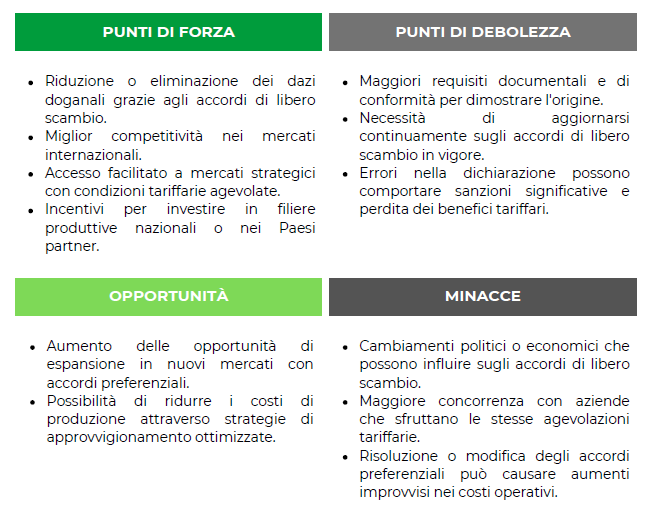
On the other hand, preferential origin represents a great opportunity for companies wishing to improve their competitiveness in international markets. Thanks to free trade agreements, goods that meet certain criteria can benefit from reduced or zero duties when exported to countries with which such agreements are in force.
The European Union, for example, has signed numerous preferential agreements with third countries, allowing goods produced in the EU to enter these markets under advantageous tariff conditions. However, to take advantage of these benefits, it is crucial that companies correctly declare the preferential origin of their goods and demonstrate that they meet the requirements set out by European regulations. Otherwise, companies may find themselves having to pay standard duties, compromising their competitiveness.
A practical example could be that of a company producing electronic components. If these components comply with the rules of preferential origin set out in the free trade agreement between the EU and Japan, the company can export its products without its Japanese customer being forced to pay high customs duties. However, incorrect declaration of origin could lead to significant economic penalties and the revocation of access to preferential markets.
The true cost of corporate negligence
The real problem, therefore, is not only the complexity of the origin of goods, but the fact that companies ignore and underestimate this issue. Many entrepreneurs still see customs compliance as a set of rules that must be followed to avoid fines, without considering that proper management of origin can turn into a competitive advantage. Ignoring the correct application of origin regulations also exposes one to reputational risks. In a world where transparency and sustainability are increasingly important to consumers, companies that do not comply with regulations may be perceived negatively, losing trust from business partners and customers. Furthermore, adherence to origin rules is essential to ensure the ethics of trade and the protection of local markets from unfair practices.
How to tackle the problem?
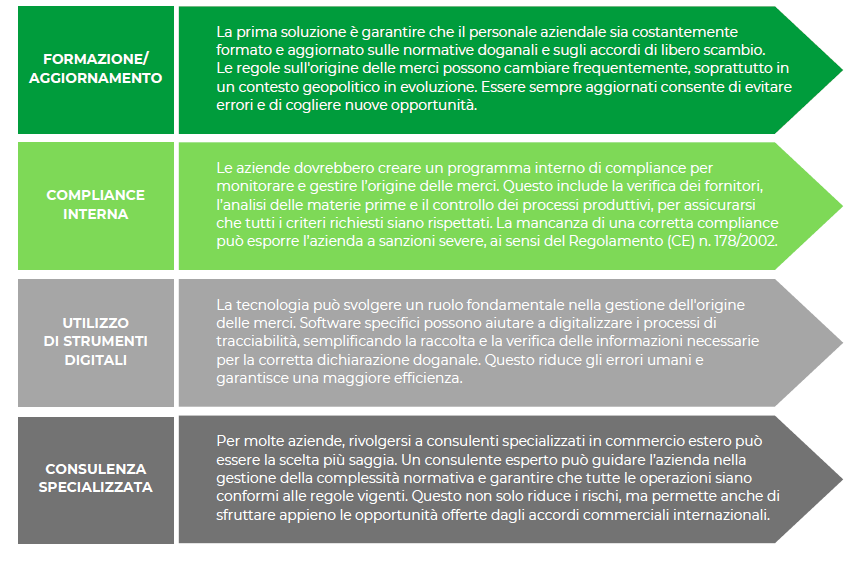
To avoid these pitfalls, companies must adopt a proactive approach to managing the origin of goods. This involves not only knowledge of current regulations but also the implementation of internal processes and tools to ensure that every stage of production and supply complies with the rules. Possible solutions:
A strategic asset for business success
The origin of goods is not just a technical detail, but a strategic element that can make the difference between the success and failure of a business operation. Companies that underestimate the importance of proper origin management expose themselves to economic, legal, and reputational risks. In contrast, those that adopt a conscious and proactive approach can gain significant competitive advantages, reducing costs and accessing strategic markets with favourable conditions.